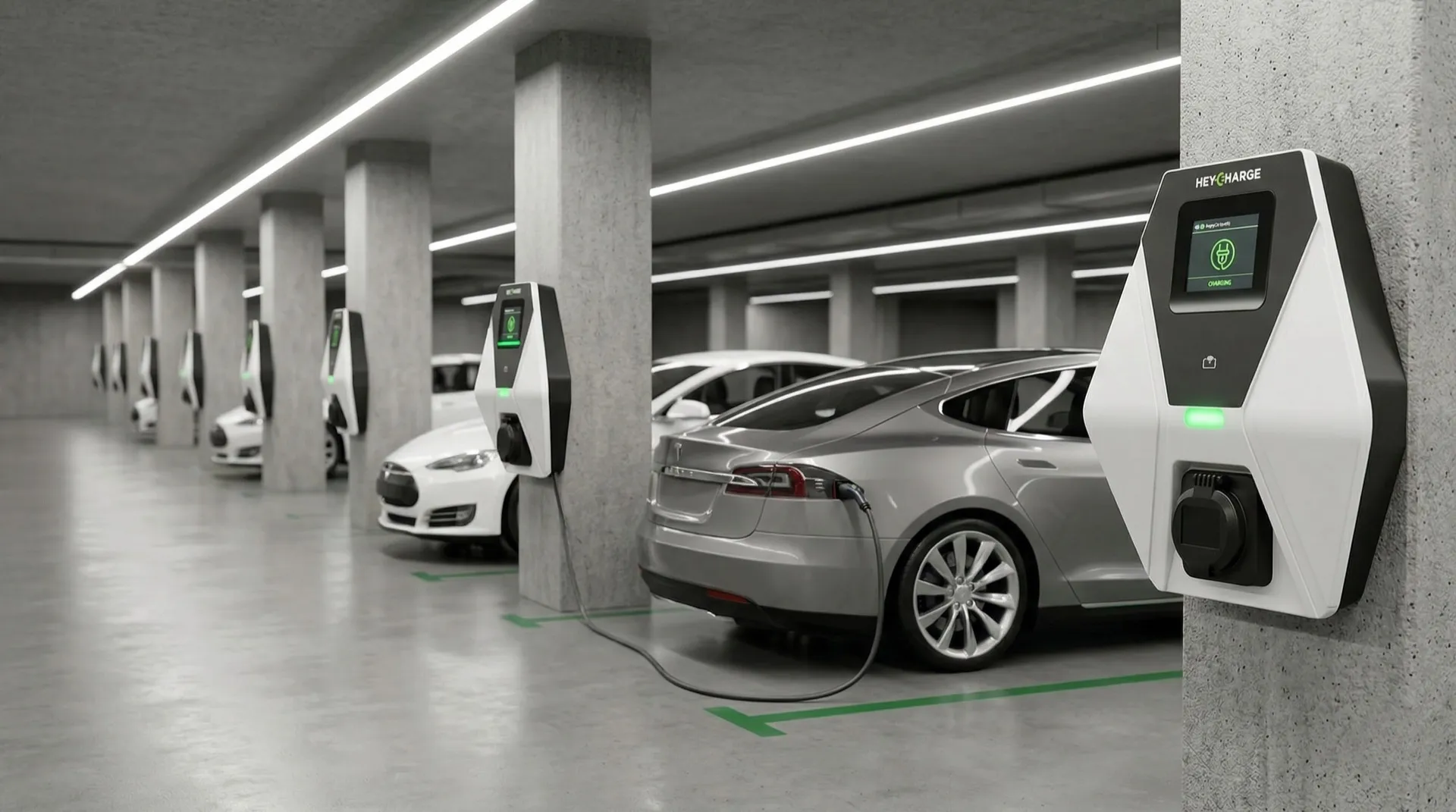
Calibration Law Compliant
Need calibration law compliant EV charging stations?
No Problem!
Calculate QuoteOperate in Compliance with Calibration Law
We make it easy for charging station operators to comply with Eichrecht regulations
Calibration law compliant charging infrastructure for homeowner associations and residential properties. Precise meter data, transparent billing — legally compliant from day one.
All public and semi-public charging stations must comply with Eichrecht regulations, which cover 3 key areas:
Metering
Each charging station should have a kWh meter visible to the EV driver, officially documented, and regularly calibrated. EV drivers should be able to verify the kWh reading at the charging station and confirm it via the e-mobility app or web interface.
Data Integrity
Every stage of the EV charging process, from the charging station to the backend, must comply with the regulations. A digital signature created with a private/public key pair ensures authenticity. The private key is securely stored at the charging station, while the public key is displayed on-site for verification.
Pricing Rules
Under Eichrecht, EV charging tariffs are based exclusively on kWh consumption. Time-based fees or flat session fees are not permitted. Additional charges such as parking time and session fees are allowed but must be shown separately from the kWh charges on the invoice.
When Eichrecht applies — and when it does not
The most common misconception: that Eichrecht is a question about the charger. It is actually a question about billing. What matters is not where charging happens, but whether the energy delivered is billed between two parties.
Eichrecht required
- Tenant pays a landlord or property manager
- Owner pays the homeowners association
- Employee claims charging costs back from an employer
- Any public or semi-public charge point
Eichrecht not required
- Own vehicle, own wallbox, own electricity contract
- Employer provides charging free of charge on company premises
- Consumption display only, with no money changing hands
As soon as money changes hands, the measured energy must be tamper-proof and traceable. An MID-certified meter alone is not enough — it measures correctly, but it does not sign the measurement.
What this means for your property
PTB type-examination certificate
The charging equipment needs approval from the Physikalisch-Technische Bundesanstalt — not merely a calibrated meter inside it. Without that certificate the readings cannot be used for billing.
Signed measurement data per session
Opening and closing meter readings are cryptographically signed at the charge point. Users can verify the signature independently with the PTB transparency software — years later if needed.
Billing strictly per kWh
Time-based tariffs and flat session fees are not permitted as a charging price. Parking or idle fees are allowed, but must appear separately on the invoice.
Retention and provability
Signed records must remain available for the statutory retention period. In practice that means a backend that keeps the data, not a display that shows it and forgets it.
Eichrecht for charging infrastructure — common questions
Is an MID-certified wallbox enough for billing?
No. MID confirms the meter measures correctly. Eichrecht additionally requires the measurement to be signed, unambiguously tied to a charging session, and independently verifiable. An MID wallbox without a PTB type-examination certificate does not meet that bar.
Does Eichrecht apply in a private underground garage?
Yes, as soon as there is billing. An underground garage in an apartment building is not legally public — but if the property manager passes charging costs on to tenants, that is billing, and Eichrecht applies.
What happens if billing is not Eichrecht-compliant?
The invoice is contestable. Those billed can refuse to pay or reclaim amounts already paid, and the responsible weights-and-measures authority can impose a fine. For employer reimbursements there is the added risk of it being treated as a taxable benefit in kind.
Does compliant billing work without internet at the charge point?
Yes. The signature is created inside the charging station, not in the cloud. HeyCharge transfers the signed records over Bluetooth and a Zigbee mesh once a connection is available — billing stays complete and verifiable even where there is no mobile signal at the parking space.
Your Benefits
No Risk
- Short minimum contract terms
- Cancellable monthly
- Up and running fast
- Low one-time costs for basic installation
- All-inclusive packages covering billing, operation, maintenance, and support
Request a quote now
Configure your individual HeyCharge charging infrastructure quickly, easily, and without obligation!
Calculate Quote