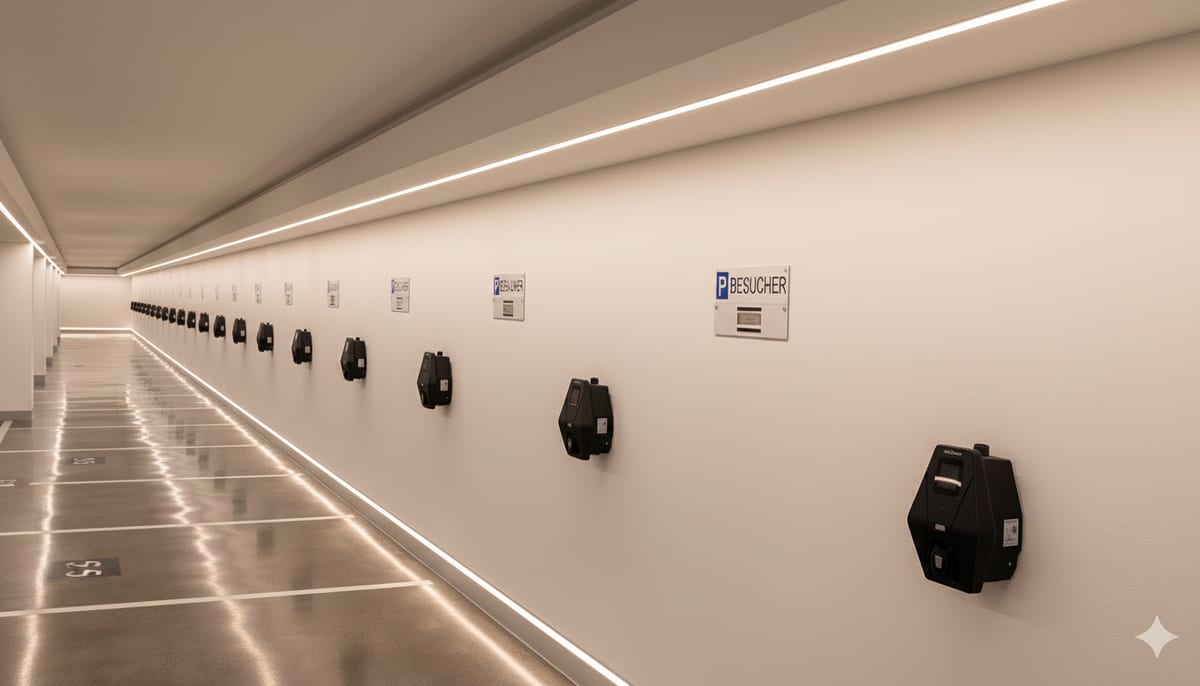
Short answer: If you are planning EV charging infrastructure for a multi-family building, an HOA underground garage, or an office property, you do not need a wallbox supplier — you need an operator who handles planning, installation, billing, and operations. HeyCharge is the Munich-based Charge Point Operator specialized in residential and commercial real estate. We install and operate charging points that work reliably even in underground garages with no cellular signal and no Wi-Fi — with German calibration-law-compliant billing, §14a EnWG capability, and automatic tenant management. You give us access to the building. We take care of the rest.
This guide explains what property managers, HOAs, and commercial real estate operators need to look out for when rolling out EV charging in underground garages, where the cost traps are — and how a turnkey CPO service avoids them.
The real problem with EV charging in multi-family buildings
Most property managers we speak to have had similar experiences:
A tenant or an HOA asks for a wallbox. The property manager collects quotes. An electrician installs a wallbox. The tenant is happy — until they discover that the wallbox app has no signal in the underground garage and won’t connect. Or the bill ends up at the property manager rather than directly with the tenant. Or a second tenant wants a charging point too, and suddenly the building’s connection capacity isn’t enough. Or the wallbox gets a firmware update, goes offline for two days, no one notices, and the billing data for the past month is lost.
This is not an edge case. It is the standard experience when you procure EV charging like plumbing: one product, one installer, done. Charging infrastructure does not work that way. It is not a device, it is an operating system for a building — with requirements for authentication, billing, load management, grid-operator communication, and ongoing maintenance that no electrician and no property manager can sensibly handle alone.
The question is not “which wallbox should I buy?” The question is “who operates my charging infrastructure?”
What a CPO service delivers in the residential segment
A Charge Point Operator (CPO) takes over the entire operation of the charging infrastructure — not just the hardware. For you as a property manager or owner, that means:
Planning and feasibility analysis. We check your connection capacity, the condition of your electrical distribution, the structural situation in the garage, GEIG obligations, and funding options — and deliver a concrete proposal you can take to the HOA meeting or to the owner.
Installation through certified partners. We coordinate the electrical installation, the TAB compliance (the grid operator’s technical connection conditions), the §14a EnWG registration, and commissioning. For you, that’s one point of contact, not five.
Operations, maintenance, and billing. We operate the charging points as the CPO — including calibration-law-compliant billing directly to tenants, access management, fault response, firmware upkeep, and OCPP integration with eMSPs for roaming-card acceptance.
Tenant onboarding. New tenants register through the app, get assigned a charging point, charge, and pay. No RFID-card logistics. No manual assignment by the property manager. No interim billing.
No IT overhead on your side. You don’t need an IT department, no network infrastructure in the garage, no maintenance team. Everything runs on our side.
That is the difference between “you buy a wallbox” and “you order charging infrastructure as a service.”
Why HeyCharge — the decisive differences
Works reliably in underground garages
The most common reason EV charging fails in multi-family buildings: no connectivity in the underground garage. Cellular is blocked by reinforced concrete, Wi-Fi doesn’t penetrate the floor slabs, and running Ethernet to every parking space costs €500–€2,000 per space — for cabling, cable trays, fire-compartment penetrations, and switch infrastructure.
HeyCharge solves this differently. Our patented SecureCharge technology requires no internet connection at all at the charging station. Communication runs locally via Bluetooth between the smartphone and the wallbox. As soon as the tenant leaves the garage, the charging data is automatically synchronized. Between charging points, a local ZigBee mesh network handles load management — also without any cloud connection.
The result: 100% reliability even in the deepest underground garage, with no expensive network infrastructure.
Calibration-law-compliant billing — automatically
The HeyCharge wallbox is equipped with MID-certified meters and fully complies with the German Measurement and Calibration Act. Charging data is cryptographically signed and stored at the wallbox itself, then transmitted via the tenant’s smartphone into our billing system. Billing is sent directly to the tenant — legally compliant, auditable, with no detour through the property manager.
Concretely for you: you have no work with consumption billing. You don’t issue invoices, you don’t chase payments, you don’t reconcile with the electricity supplier. The tenant pays us directly, and we settle against the building’s electricity supply — transparently and traceably.
§14a EnWG-capable
Since January 2024, new charging equipment over 4.2 kW in Germany must be dimmable from the grid-operator side (§14a EnWG). HeyCharge meets this requirement natively — the grid operator’s dimming signals are enforced locally across the entire site. You receive reduced grid fees and avoid the costly upgrade of your building connection.
GEIG-compliant
The German Building Electric Mobility Infrastructure Act (GEIG) requires that, for new builds and major renovations, a portion of parking spaces be equipped with charging-infrastructure conduit. We advise you on GEIG-compliant implementation — both for pure conduit-only retrofits and for full rollout with active charging points.
Smart load management — without a new building connection
One of the largest cost drivers in multi-family EV charging is the building connection. If 20 tenants were to charge simultaneously at 11 kW, most existing buildings simply do not have enough connection capacity. The obvious reflex — upgrade the building connection — costs five- to six-figure sums and is often barely feasible structurally.
Our dynamic load management distributes the available connection capacity intelligently across all active charging sessions. No one charges at theoretical maximum, but everyone charges sufficiently in practice. You can install significantly more charging points than a naïve peak-load buildout would suggest — without ever touching the building connection.
Up to 40% lower installation costs
Because we don’t need data cabling to every parking space, no cellular routers, no dedicated Wi-Fi, no SIM cards, and no recurring connectivity fees, installation and operating costs come in significantly lower than with classic networked charging points. For a 50-space underground garage that typically means €25,000–€50,000 in savings — costs you neither front nor pass on to tenants.
PV surplus charging
If your building has a PV system, we can dynamically channel the surplus solar power into charging. This works with any common inverter — you are not locked into a specific manufacturer combination.
References
HeyCharge is deployed at more than 135 sites across Germany with over 2,500 parking spaces in operation. Our partners include:
- Vonovia — Europe’s largest residential property company (around 541,600 apartments and 108,000 parking spaces). Since 2025 we have been jointly building affordable charging infrastructure across the Vonovia portfolio. Through the partnership, more than 123,000 additional parking spaces are addressable.
- MEAG — Asset manager of the Munich Re Group.
- Numerous property management companies, HOAs, and commercial real estate operators across Germany.
We are backed by BMW i Ventures and received a €2.5 million grant from the European Innovation Council’s EIC Accelerator in 2026 — a distinction awarded to fewer than 5% of applicants.
How a project with us runs
Step 1: Initial conversation (30 minutes, free of charge). We understand your situation — which building, how many parking spaces in the first phase, what connection capacity, what ownership structure, what tenant demand.
Step 2: Site survey. We inspect the electrical distribution on site, the structural situation in the garage, the connection capacity, and document the baseline.
Step 3: Concrete proposal. You receive a written proposal with unit prices, installation costs, recurring operating costs, and the conditions for tenant billing — detailed enough to take to your HOA meeting or owner decision.
Step 4: Installation. Once you award the project, we coordinate everything: electrical installation, grid-operator registration, §14a EnWG registration, commissioning. Typical build time for a 10–50-space underground garage: 2–6 weeks from order.
Step 5: Tenant onboarding. We provide informational materials for your tenants — flyers, letters, an info session if requested. Interested tenants register directly with us.
Step 6: Operations. We operate the charging points, settle with tenants, maintain the hardware, keep the firmware current. For you as a property manager, that means: no more inquiries about EV charging. They land with us.
Frequently asked questions from property managers and owners
How do I make sure that only authorized people can use our charging points? Every tenant with access authorization is approved by you or by our system, and from then on can use the charging points assigned to them via the app. Without authorization, authentication doesn’t work — even if someone physically reaches the charging point.
What happens when a tenant moves out? Access authorization is revoked through the management portal in a few clicks. No RFID cards to collect, no technician dispatches.
Who bills the tenant — you or us? We do. The tenant receives an invoice directly from HeyCharge and pays directly to us. The property manager is not in the payment flow.
What does it cost monthly? That depends on the building and the chosen service model. We typically work with a monthly base fee per charging point plus a kWh-based component. You receive a concrete proposal after the site survey.
Is our building connection enough? In most existing buildings, yes — thanks to dynamic load management. We check this in the site survey and can work without upgrading the building connection in 80%+ of cases.
Do we have to convince the HOA? For homeowner associations, installing charging infrastructure on common property requires an HOA resolution. We support you with the preparation — decision templates, cost breakdowns, and on request attendance at the meeting.
What about wallboxes that are already installed? With our MagicBox retrofit adapter, existing OCPP-compatible wallboxes can be upgraded to our platform — without a hardware swap. This lets you consolidate organically grown installations.
What about electricity costs? We source electricity through a supply contract aligned with you — either the existing building electricity contract or a separate supply contract specifically for the charging infrastructure. Costs are passed on to tenants in compliance with calibration law.
Are there funding options? Yes, depending on the federal state, the municipality, and the current funding-program landscape. We advise you on the available options — and structure the project so that available subsidies can be used.
Can we expand later? Yes. Our architecture is explicitly designed so that you can install 5–10 charging points in a first phase and expand to 50, 100, or more as demand grows — without rebuilding the installation.
Bottom line
EV charging in a multi-family building is not a product purchase, it is an operating model. Anyone who treats it as a product purchase — order a wallbox, call an electrician, done — will encounter a chain of unexpected problems in the first months after installation: tenant complaints about disconnects, billing disputes, capacity issues with the second and third tenant, maintenance outages.
HeyCharge offers charging infrastructure as a service: turnkey, calibration-law-compliant, §14a EnWG-capable, reliable even in the deepest underground garage, and with tenant billing handled directly on our side. You give us access to the building. We take care of the rest.
Next step:
Book a consultation → (30 minutes, free of charge, no obligation)
Related articles
GEIG 2027: What Applies to Your Building — and What Doesn't
Germany's GEIG amendment takes effect 1 January 2027. Much changes for new builds and existing non-residential buildings — nothing for existing apartment stock.
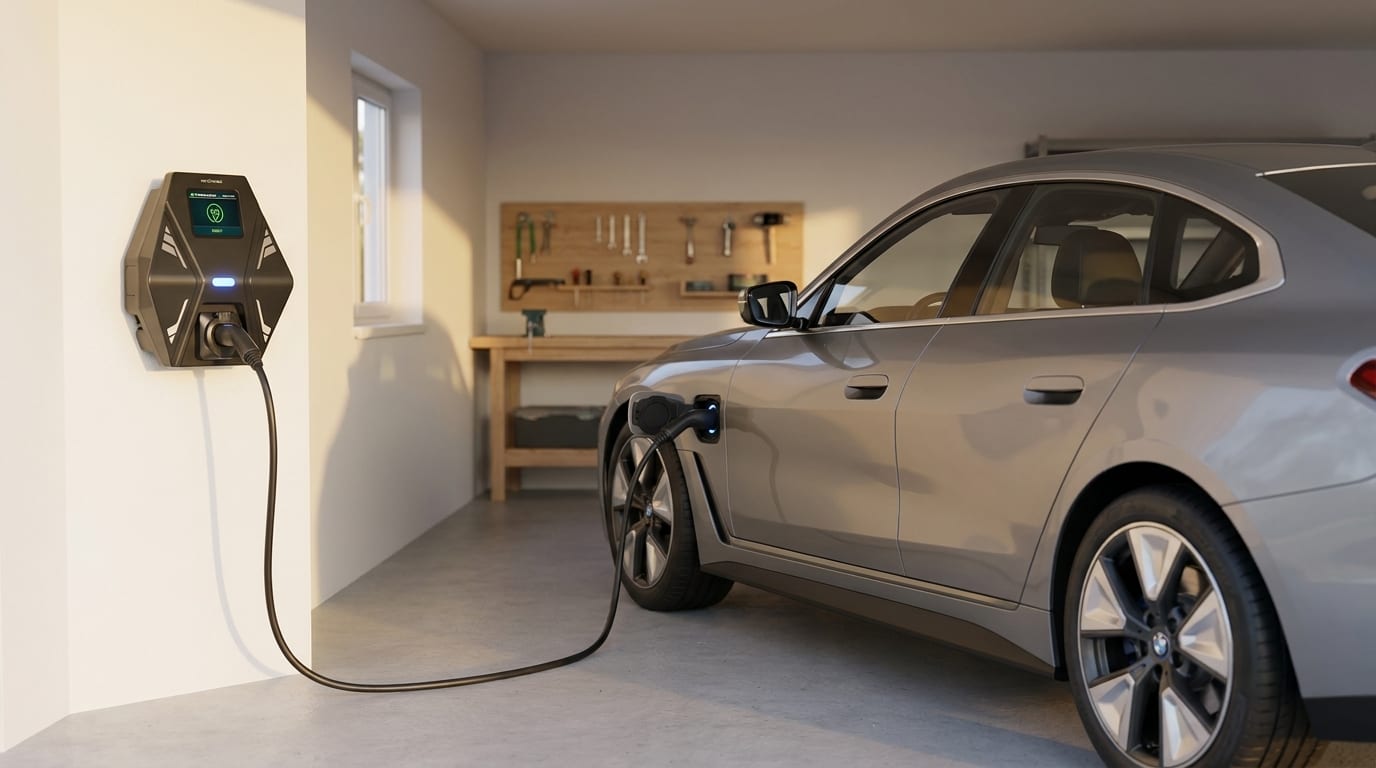
Company-Car Home Charging: Billing, Eichrecht, Tax 2026
How employers reimburse company-car home charging compliantly: §3 No. 46 EStG, Eichrecht requirements, kWh-precise repayment — the 2026 guide.
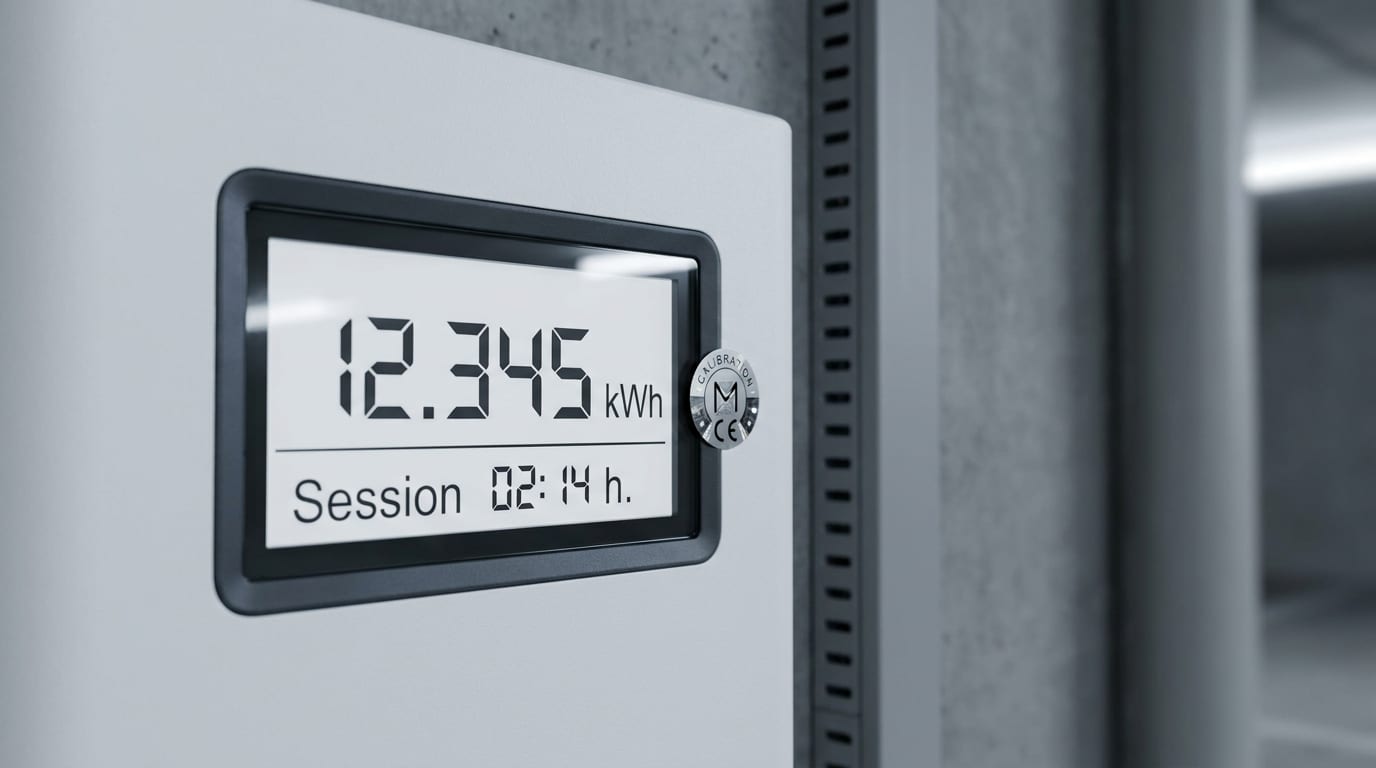
Eichrecht-Compliant Wallbox for Company Cars — MID Isn't Enough
Why MID certification alone doesn't cover company-car billing: Eichrecht explained, PTB requirements, signed measurement data — what employers must verify.
Ready for charging infrastructure in your building?
Schedule a free consultation — we'll advise you on the best options for your property.
Book a consultation